
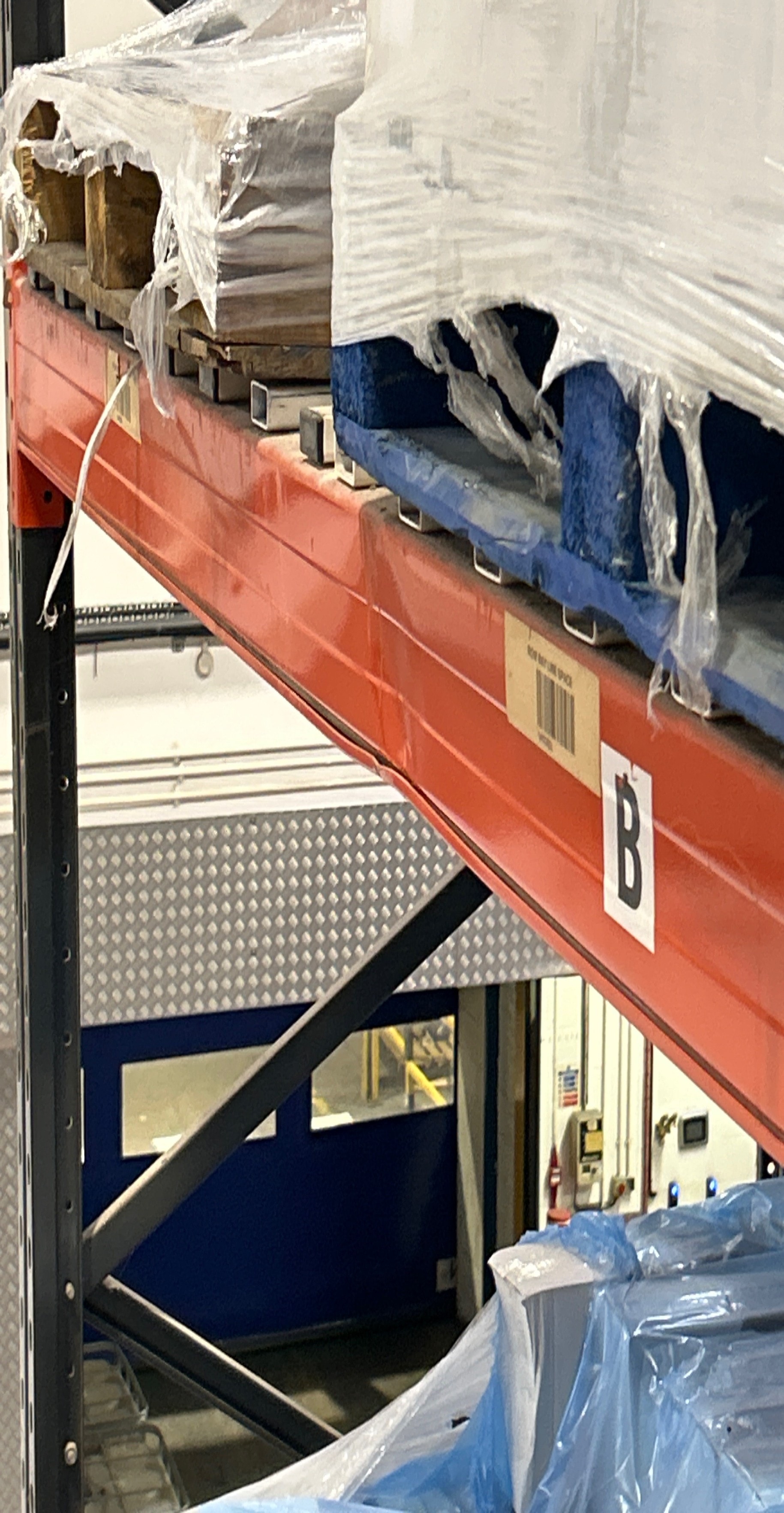
Red and Amber Risk Repairs: Getting Your Racking Back in Service Before Peak
When a racking inspection identifies Red or Amber Risk defects, the next question is straightforward: how quickly can they be repaired?
The answer matters more than it might seem — particularly if you're approaching peak season with a list of outstanding findings.
What Red and Amber Risk actually mean for your operation
Red Risk findings require the affected area to be immediately offloaded and isolated from use until repairs are completed. That means a pallet location — or multiple locations — that are out of service until the work is done.
Amber Risk findings require remedial work within 4 weeks. Immediate offloading is not required, but once affected pallet locations are emptied they must not be refilled until repairs are completed. If not repaired within 4 weeks, the item becomes Red Risk. In practice, Amber Risk findings are where backlogs tend to build up — they're significant enough to note, but not so urgent that they force immediate action, so they get scheduled, rescheduled, and quietly carried forward.
Approaching peak with a backlog of Amber Risk repairs means approaching peak with a racking system that isn't in the condition it should be, and with locations that are technically in use but carrying unresolved damage.
What the repair process involves
A proper racking repair isn't a patch job. It means replacing damaged components — uprights, beams, bracing, base plates — with the correct parts, to manufacturer specification.
That process involves:
Assessment — Understanding exactly what needs to be replaced and sourcing the correct components. Not all racking is the same, and using incorrect components can create new problems.
Preparation — The affected bay needs to be unloaded before work begins. In a busy warehouse, that requires coordination with your operations team.
Installation — Replacement components are fitted to manufacturer specification. For upright replacements, this typically involves removing the damaged section, fitting the new component, and checking verticality.
Verification — Once the repair is complete, the bay is checked to confirm it's back in service correctly.
Why timing matters
The earlier you start the repair process, the more time you have before peak. That sounds obvious, but it has practical implications.
Components need to be sourced. For some racking systems, particularly older installations, sourcing the correct replacement parts can take time. Starting the process in September or early October gives you a much better chance of having repairs completed before peak than starting in November.
Scheduling also matters. If multiple bays need repair, the work needs to be sequenced in a way that minimises disruption to your operation. That's easier to manage with time to plan than under pressure.
Recovering pallet locations
The goal of completing repairs before peak isn't just compliance — it's capacity. Every repaired bay is a pallet location returned to service. For a warehouse that's been carrying unresolved damage, completing repairs before peak can meaningfully increase the number of locations available when you need them most.
At True Space Solutions, we've completed repairs for customers across the Midlands who've headed into peak with more usable space than they had before — because they acted on their inspection findings rather than carrying them forward.
What we do
We carry out repairs to manufacturer specification across the Midlands. We respond quickly, source the correct components, and complete the work with minimal disruption to your operation.
We're not just an inspection company. We're the team that helps you move from identifying the problem to getting it resolved — and getting your pallet locations back in service before peak.