
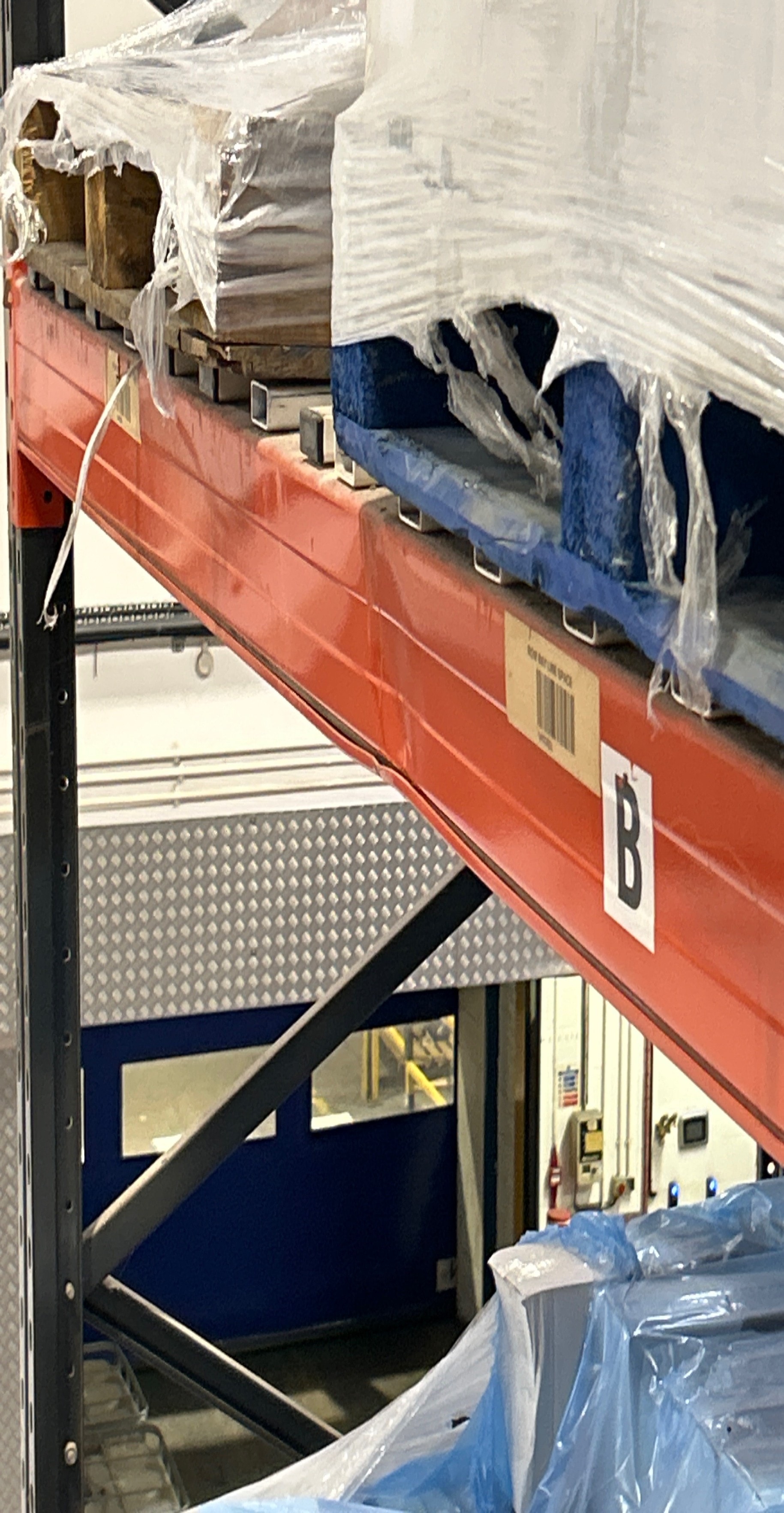
Why Damaged Racking Costs You More Than a Repair Bill
When warehouse managers think about the cost of damaged racking, they usually think about the repair bill. The cost of replacement components. The time it takes to get someone in.
That's understandable. But it's not the whole picture.
The capacity cost
Every Red Risk finding means a bay is out of service until the repair is completed. That's not a theoretical risk — it's a practical one. The affected location can't be used. Stock has to go somewhere else. Your available pallet locations are reduced.
For a warehouse running at normal capacity, that's manageable. For a warehouse approaching peak season, it's a different calculation entirely.
Peak is when you need every pallet location. It's when stock volumes are highest, throughput is fastest, and the pressure on your warehouse is greatest. Heading into that period with unresolved racking damage means heading in with less space than you should have.
The Amber Risk problem
Red Risk findings are hard to ignore — the guidance is clear that affected bays should be unloaded and restricted until repaired. But Amber Risk findings are often where the real capacity problem builds up.
Amber Risk means the damage requires remedial work within 4 weeks. Immediate offloading is not required, but once affected pallet locations are emptied they must not be refilled until repairs are completed — and if the repair isn't done within 4 weeks, the item becomes Red Risk. In practice, that often means the finding gets noted, logged, and then quietly deprioritised.
Over time, a warehouse can accumulate a number of unresolved Amber Risk findings — each one representing a location that's technically in use but carrying unresolved damage. Approaching peak with a backlog of Amber Risk repairs means approaching peak with a racking system that isn't in the condition it should be.
The timing problem
Racking repairs take time to arrange. Components need to be sourced. A team needs to be scheduled. The work needs to be completed safely, with the affected bays unloaded and the area managed appropriately.
If you wait until October to start thinking about repairs, you may find that the window before peak is shorter than you'd like. The warehouses that head into Q4 in the best condition are the ones that identified their issues in September and acted on them promptly.
What fast repairs actually look like
At True Space Solutions, we carry out repairs to manufacturer specification across the Midlands. When a customer has a racking problem, we respond quickly, assess what's needed, and complete the work efficiently.
That means damaged uprights, beams, and connectors replaced properly — not patched or worked around. It means pallet locations returned to service. And it means heading into peak with a racking system that's in the condition it should be.
From inspection to repair. We keep things moving.
On a recent Midlands inspection, we identified a significant number of Red Risk and Amber Risk defects in a single facility. The client had no idea. Their racking had been in use for years without a formal assessment. The cost of addressing those findings was significant — but the cost of heading into peak without addressing them would have been higher.
The straightforward answer
If you have unresolved racking damage, the straightforward answer is to get it repaired before peak arrives. Not because the repair bill is cheap — it may not be — but because the alternative is heading into your busiest period with less capacity than you should have, and a racking system that isn't in the condition it needs to be.